

Roatán Real Estate Market Report for January to October 2026
If you’ve been wondering whether now is a good time to buy in Roatán, the numbers through October give a pretty clear answer. It’s a buyer’s market here, and prices are holding anyway.
I pulled the figures from our local Roatán MLS for January through October 2026 and lined them up against the same ten months of 2025. Here’s what they show and what I’d do with them.
And keep an eye on the East End. While roads in the Camp Bay area undergo major upgrades, and local government beach cleanup protocols are increasingly structured, 2027 may be the year for the East side. More on that below.
Roatán Sales and Inventory in 2026
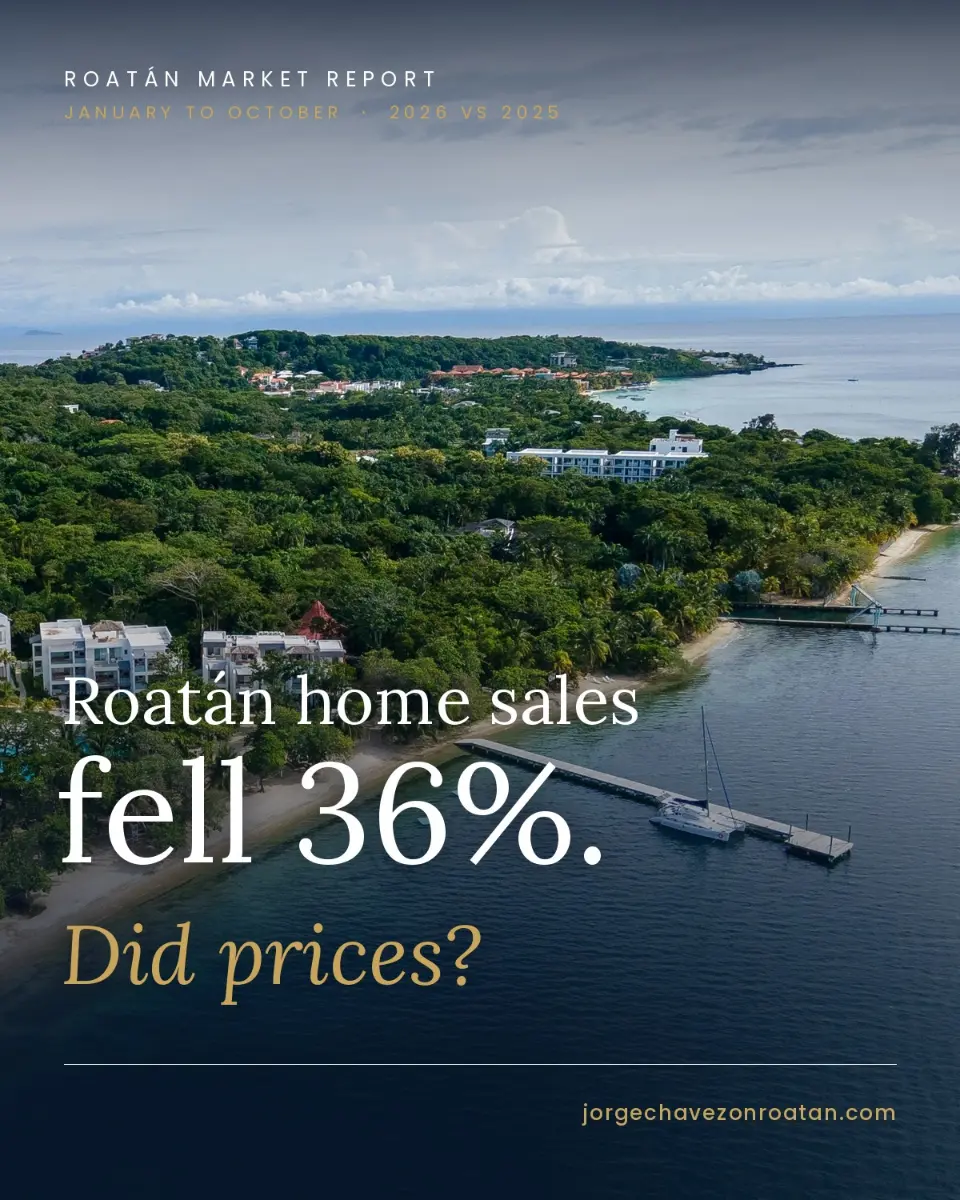
Through October, 98 homes and condos closed on Roatán through the MLS. Over the same stretch last year it was 153, so we’re looking at about 36% fewer sales.
Meanwhile more homes keep coming on the market. We had 355 new listings this 10 months and we still have two more months to compare with 322 last year, and active inventory sat at 326 homes in October, up from 283 a year earlier.
You’d expect prices to drop with numbers like that. They didn’t. The median sale price came in at $356,500, up from $340,000, and the average was $412,296, up from $396,421.
How Much Inventory We Actually Have
Here’s a simple way to think about inventory: Say nobody listed another home on Roatán starting tomorrow. At the rate homes are selling right now, about 10 a month, how long would it take to sell the 326 that are already on the market? The answer is 32.6 months. Agents call that the absorption rate. A year ago it was 21.9 months.
Comparatively with the U.S. market, anything over six months counts as a buyer’s market. We’re close to three years. (Yes, I double-checked.) I often highlight the ways the Roatan market differs from the U.S. markets, but the fact that Roatan’s absorption rate is over 2 years makes it undeniable that the market climate favors the buyer.
Here’s the nuance: the homes that do sell are selling a bit faster. Days on market just means how long a home was listed before somebody bought it. For the homes that sold this year, the median was 244 days, down from 280 last year. When I examine both factors, it becomes clear that this is a market where the well-priced places sell and the rest remain on the market a while longer.
Information to know about key areas: What’s hot and what’s not?
I don’t believe speaking about real estate in the diverse communities of Roatan as one market, painting them all with the same brush, is helpful to buyers. West Bay and Sandy Bay don’t move at the same speed, and a $200,000 condo doesn’t sell at the same rate as a $1 million home.
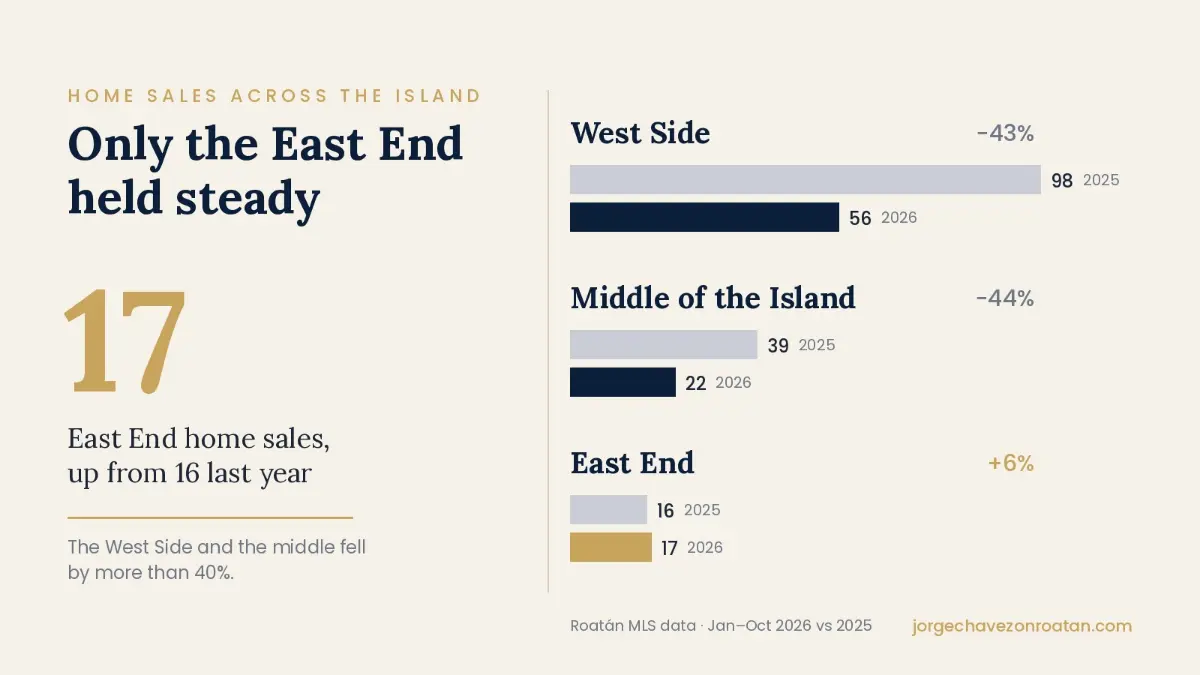
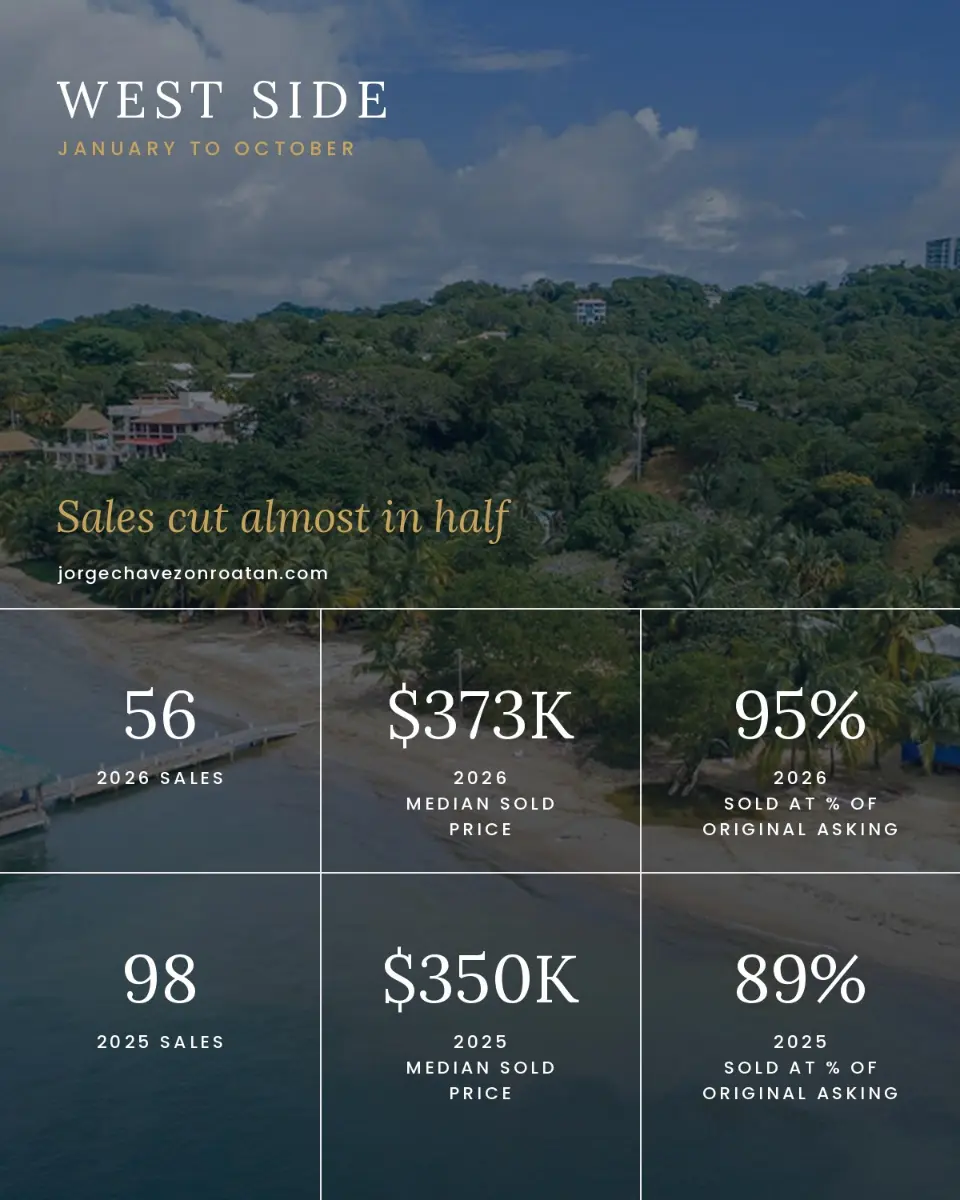
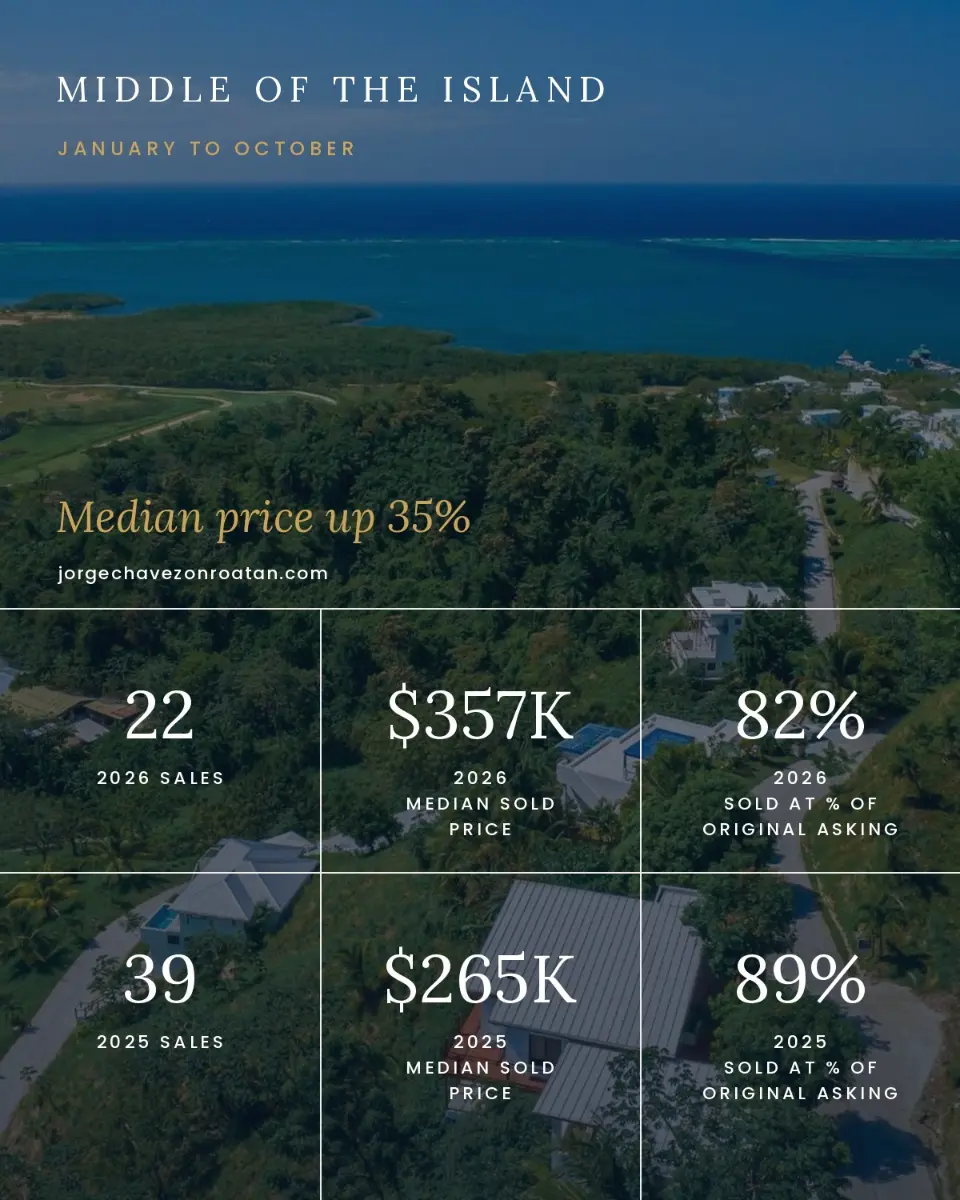
As the West Side still consistently sells more homes, its market also took the biggest hit. From West Bay to Sandy Bay and Flowers Bay, 56 homes and condos closed between January and October, down from 98 last year. The middle of the island, from DIxon Cove through French Harbour and Parrot Tree, dropped from 39 sales to 22. The median West Side home sold for $372,500, and in the middle of the island it was $356,500. West Bay alone had 27 sales, more than any other single area. Many might have expected West Bay to be immune to the decrease in sales, but it remained fairly consistent with the rest of the Western part of the island.
Even West Bay slowed down, though. Over the same ten months last year there were 60 sales in West Bay, so it’s down by more than half. The median West Bay sale this year was $487,000, up from $375,000, so the buyers who are closing there are spending more. Two beachfront condos at Watercolors in West Bay closed this year at $735,000 and $740,000, both cash.
West End is the one to watch. Active listings there roughly doubled over the past year, with only 7 sales so far. That’s a lot of choice for a buyer and a lot of competition for a seller. Many prefer being close end to the West End village for its sleepy vibe and its convenient access, as the West End market for rentals in remains consistent.
The East End of Roatán
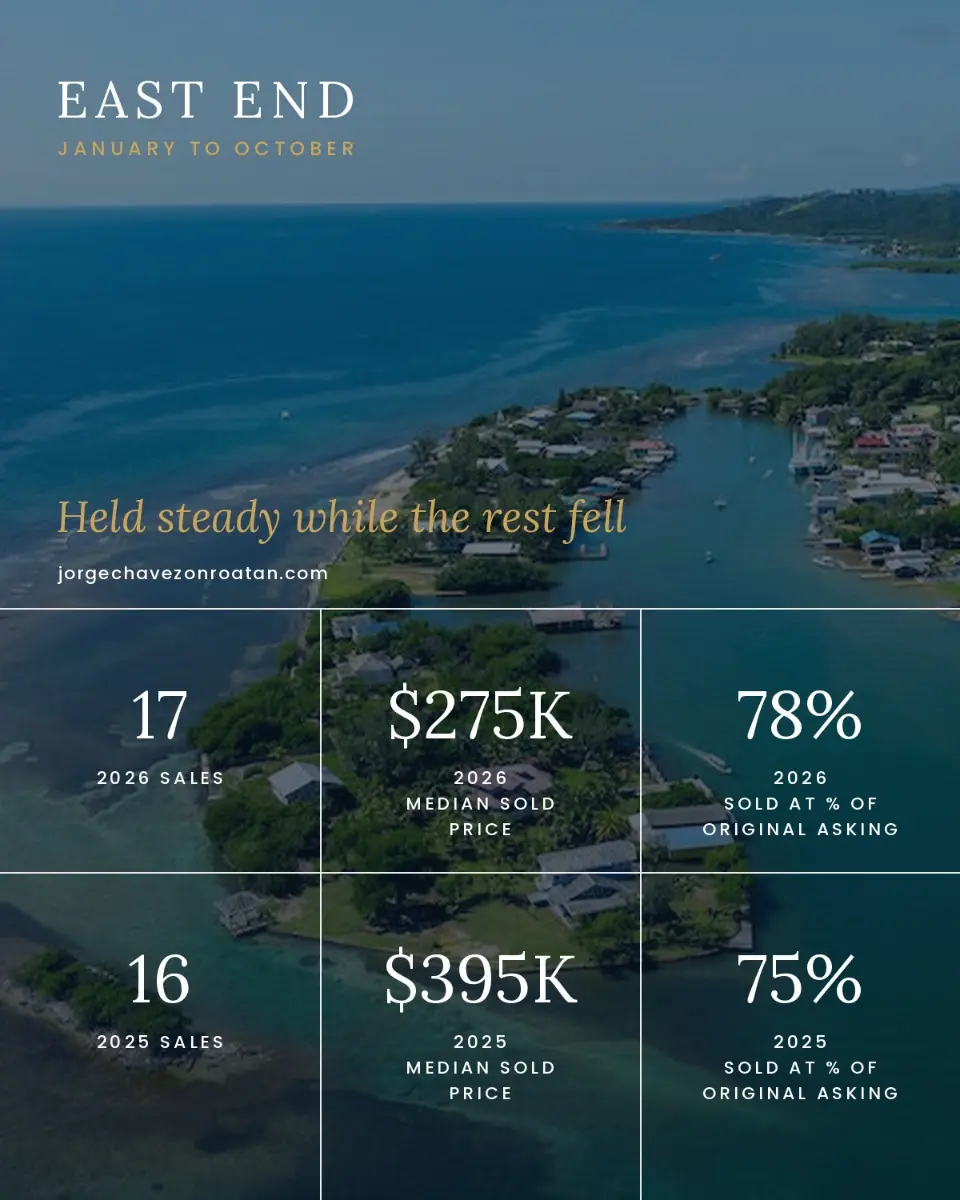
Here’s the surprise. From First Bight and Milton Bight out to Camp Bay Calabash Bight and Port Royal, 17 homes closed on the MLS between January and October, up from 16 over the same months last year. While the rest of the island fell by 40% or more, the East End held steady and even added a sale. Land was a different story out there, with 17 lots and parcels sold, down from 24. And you pay less to get in. The median East End home sold for $275,000 this year. On the West Side it was $372,500.
A word of caution on that East End median, though. It fell from $395,000 last year, and a big part of that is which homes happened to sell. With fewer than 20 sales a year out there, a couple of bigger closings can move the number a lot.
Land works the same way. The median East End lot sold for $80,000, compared with $117,500 across Roatán. East End sellers also gave up the most at the table. Homes out there closed at about 78% of their original asking price, so buyers had real room to negotiate.
A couple of East End homes that sold this year show what that buys you. A 3,569-square-foot ridgetop home in Punta Blanca was listed at $349,000, and an ocean-view home on 2.92 acres nearby was listed at $395,000.
What’s Changing Out East
There’s a lot happening on the East End that doesn’t show up in the MLS numbers yet. Roads are getting paved, and more improvements are on the way. Garbage is getting picked up all over. Honestly, it just feels a little more organized out there.
The community is getting involved, and the mayor’s office is doing a good part of the work too. When the people who live out east and the local government pull in the same direction, the infrastructure starts to catch up. That’s what I’m seeing right now.
We are also seeing new homes coming to market out east, in First Bight, Jonesville, Diamond Rock, Punta Blanca, Milton Bight and Calabash Bight. If you want more space for your budget and you don’t mind a slower pace, those areas are worth a serious look.
What’s Happening on the Rest of the Island
It’s not just the East End. On the Roatán municipality side, from West Bay through French Harbour, there’s more Cruise ship traffic has definitely picked up, and a few new flights are coming in. The Canadian flights have started back again too.
You’ll also see starting to see new commercial buildings and new infrastructure going up all over the island. The municipality keeps doing its part, and you can see it when you drive around.
Where Buyers Are Spending
This is the number that jumped out at me. Homes priced at $500,000 and up make up 40% of what’s for sale right now (130 of 326 listings). They made up about 25% of what actually sold this year (24 of 98).
Under $300,000 it flips. About 38% of this year’s sales happened under $300K, while only about a quarter of current listings sit in that range.
So if you’re shopping above half a million, you have choices and time. If you’re shopping under $300K, the good ones don’t hang around long.
What’s Happening With Land
Land is moving differently from homes. Through October, 64 lots and parcels closed on Roatán, down from 75 last year. But far fewer new lots are coming on the market (220 new listings compared with 294), and active land inventory dropped to 295 in October from 356 a year ago.
The median land sale came in at $117,500, up from $73,000. Before anyone gets too excited, a big part of that jump is which lots sold. The cheap lots mostly stopped selling, and sales under $70,000 fell from 32 to 14. So read it as a change in what’s selling more than a 60% jump in what the same lot is worth.
It’s still a slow market for land. At October’s pace there’s close to 50 months of supply, and the median lot took 311 days to sell, up from 218. If you’re buying land, you have time and room to negotiate. If you’re selling it, the good news is that the pile of competing lots is getting smaller.
Looking at each part of the island, the middle was the bright spot for land. From Dixon Cove through French Harbour, 23 lots and parcels sold, up from 21 last year. The West Side dropped from 28 to 22, and the East End from 24 to 17.
Asking Price vs Sale Price
A lot of sellers price their home on what they put into it, or on what someone down the road is asking. I get it, and that’s where it gets tricky. Every sale here is different. Your neighbor may have bought in a completely different market, and an asking price is just a number until somebody pays it.
Buyers set the value. They can see everything else that’s for sale, and what similar places actually sold for. That’s where an experienced agent makes the difference. A realistic price from day one is what keeps a property from sitting on the market.
The sale numbers show the gap. Homes on Roatán closed at about 93% of their last asking price this year, and about 89% of the price they first hit the market at. The difference between those two numbers is the price cuts that happened while houses sat. Where you buy matters a lot here. On the West Side, homes closed at about 95% of their original asking price. In the middle of the island it was 82%, and on the East End it was 78%.
New construction adds its own pressure. A developer with fresh finishes is chasing the same buyer as a ten-year-old resale down the road.
Advice for Buyers
You have room to negotiate this year. More inventory means you can compare neighborhoods and look hard at condition before you commit.
Just don’t mistake a slow market for a fire sale. Prices held. The good deals come from knowing which listings are priced on hope and which are priced on what’s actually closing.
A buyer’s market never lasts as long as you want it to. You can, of course, wait and keep researching.
Advice for Sellers
What a lot of agents won’t tell you is that pricing off other listings is how a property ends up sitting. Price on closed sales. In my experience, the properties that sell are the ones that hit the market at the right number, and the ones that start high usually end up with a price cut or two anyway.
That’s not fun to hear. I’d still rather tell you now than six months into a listing.
About These Numbers
These figures come from our local Roatán MLS and cover Roatán only, January 1 through October 31, 2026, compared with the same period in 2025. The MLS also covers Utila and Guanaja, and I left those out. Roatán is officially split into two municipalities, Roatán and Santos Guardiola, but buyers shop by side of the island, so I grouped the MLS areas into the West Side, the middle of the island and the East End. My East End runs from First Bight and Milton Bight out past Calabash Bight and Camp Bay to Port Royal. Plenty of developer and private sales on Roatán never hit the MLS, so treat this as a solid sample of the market and not the whole picture.
I also didn’t lean on October by itself. With only 10 home sales on Roatán that month, one big closing can swing the averages all over the place. That’s the kind of thing you only learn after years of watching this market.
Let’s Talk About Your Plans
Over the years I’ve learned a thing or two about this market, including what these numbers mean for a specific neighborhood or price range. If you want to know what your own place would realistically sell for, or what a fair offer looks like on a property you’ve got your eye on, get in touch. I’ll give you the real numbers, including the ones you’d rather not hear.
And if the East End caught your eye, reach out and I’ll send you what’s selling out there right now.

Keeping it real,
Jorge


